
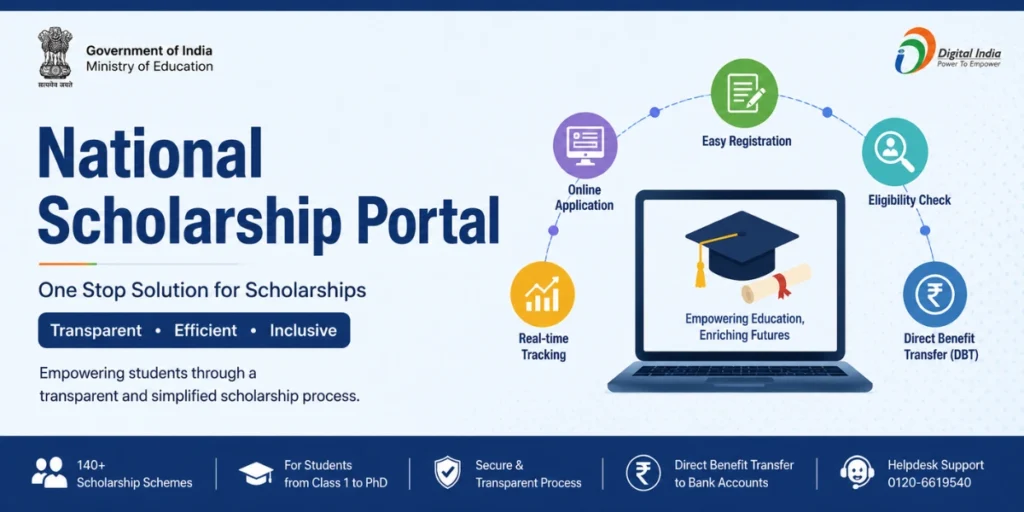
National Scholarship Portal (NSP) 2026 offers more than 140 scholarship schemes for students from Class 1 to Ph.D. It provides a simple online application process, eligibility verification, Direct Benefit Transfer (DBT), and transparent scholarship status tracking.
The National Scholarship Portal (NSP) 2026 is a flagship digital platform of the Government of India designed to simplify access to scholarships for students at different stages of education. From school students to doctoral scholars, eligible candidates can use the portal to find suitable schemes, submit applications, complete verification, and track their scholarship status online.
The portal brings multiple scholarship schemes together on a single platform, making the overall process more convenient and transparent. Through Direct Benefit Transfer (DBT), approved scholarship payments are transferred directly to the beneficiary’s eligible bank account, helping reduce intermediaries, delays, and the possibility of financial leakages.
National Scholarship Portal (NSP) 2026
The National Scholarship Portal (NSP) 2026 is an integrated online scholarship platform operated by the Government of India. It brings together more than 140 scholarship schemes from different government departments and organizations under one digital system.
The portal is designed to serve students ranging from Class 1 to Ph.D. level. Through NSP, students can check scholarship eligibility, register online, submit applications, complete the required verification process, and monitor the progress of their applications.
By providing these services through a unified platform, NSP 2026 makes the scholarship process more accessible, efficient, and transparent for students across India.
National Scholarship Portal (NSP) 2026 Objectives
The National Scholarship Portal (NSP) 2026 has been developed with several important objectives to make the scholarship application and payment process simpler, more transparent, and accessible for students across India.
- Centralization: To bring Central Government, State Government, UGC, and AICTE scholarship schemes together on a single online platform, making them easier to access.
- Improved Efficiency: To simplify the complete scholarship process, from application and verification to approval and fund disbursement, while reducing paperwork and delays.
- Transparency: To create a transparent system with proper tracking and audit records through integration with platforms such as PFMS and Direct Benefit Transfer (DBT).
- Accountability: To monitor applications through different verification levels, including institute, district, and state authorities, helping minimize errors and fraudulent applications.
- Inclusivity: To improve scholarship access for students belonging to disadvantaged groups, including SC, ST, OBC, minorities, and Persons with Disabilities (PwD).
- Real-Time Monitoring: To provide students and government officials with updated application information, dashboards, and scholarship status details.
- Simplified User Experience: To make the process easier through a unified application system, eligibility-based scheme selection, and online application status tracking.
- Prevention of Duplication: To help prevent students from applying for or receiving multiple scholarships for the same academic period when such duplication is not permitted.
- Secure Fund Transfer: To facilitate secure scholarship payments through DBT, allowing approved funds to be transferred directly to eligible bank accounts linked with Aadhaar, where applicable.
- Policy Support: To generate useful data and insights from scholarship applications, approvals, and disbursements, helping policymakers improve scholarship programs and planning.
National Scholarship Portal (NSP) 2026 Purpose
The National Scholarship Portal (NSP) 2026 is designed to make scholarship access easier, more transparent, and more efficient for students across India. Its purpose can be understood through several social, economic, and administrative goals:
- Promoting Social Equity: NSP helps reduce financial barriers to education by providing scholarship opportunities to eligible students from communities such as SC, ST, OBC, minorities, and Persons with Disabilities (PwD).
- Reducing Dropout Rates: Financial support can encourage students from economically weaker families to continue their education and complete school, college, and higher studies.
- Easy Access to Scholarships: The portal replaces many traditional paper-based processes with a centralized digital platform where students can apply for and manage scholarship applications online.
- Direct Benefit Transfer (DBT): Scholarship payments are transferred directly to eligible beneficiaries’ bank accounts through DBT, helping reduce intermediaries, payment delays, and the risk of financial irregularities.
- Accountable Governance: Multiple levels of application verification, including institute and district-level authorities, help improve accountability and ensure that applications are properly checked before approval.
- Data-Based Planning: Scholarship application and distribution data can help government authorities understand demand, identify gaps, and make better decisions regarding policies and budget allocation.
- Administrative Efficiency: By bringing scholarship-related processes onto one platform, NSP can reduce repetitive administrative work for government departments, states, and educational institutions.
National Scholarship Portal (NSP) 2026 Eligibility
The eligibility criteria for National Scholarship Portal (NSP) 2026 vary according to the specific scholarship scheme. However, many scholarships have some common requirements that students may need to fulfill:
- Educational Level: Depending on the scheme, students studying from Class 1 through Ph.D. level may be eligible to apply.
- Family Income: Many scholarships have an annual family income limit. The income threshold differs from one scheme to another. For example, certain pre-matric and disability-related scholarships may have an income ceiling of ₹2.5 lakh per year, while the National Means-cum-Merit Scholarship Scheme (NMMSS) has a specified parental income limit of ₹3.50 lakh per year.
- Academic Performance: Some scholarships require students to achieve a minimum percentage or equivalent grade. Certain schemes may also require students to qualify for an examination or selection test.
- Category Requirements: Some scholarships are specifically intended for particular groups, such as SC, ST, OBC, Minorities, or PwD students. Category-specific conditions depend on the individual scheme.
- Aadhaar and Bank Account: Students may need an Aadhaar-linked or Aadhaar-seeded bank account to receive scholarship payments through DBT, subject to the applicable scheme requirements.
- Recognized Institution: Applicants generally need to be enrolled in a recognized school, college, university, or other eligible educational institution as specified by the scholarship guidelines.
- Renewal Requirements: Students applying for renewal may need to maintain satisfactory academic progress and meet the conditions prescribed by their scholarship scheme. In many cases, the scholarship must also have been awarded in the previous academic year.
- Nationality: Most scholarships available through NSP are intended for Indian citizens, although the exact nationality requirements depend on the individual scheme.
- Required Documents: Depending on the scholarship, applicants may be asked to provide documents such as an income certificate, caste or category certificate, domicile certificate, previous academic marksheets, Aadhaar details, and bank account information.
Note: Eligibility conditions, income limits, required documents, and other requirements can differ significantly between scholarship schemes. Students should always check the specific scheme guidelines before submitting their NSP application.
Types of Scholarships under National Scholarship Portal 2026
The National Scholarship Portal (NSP) 2026 brings together a wide range of scholarship programs offered by the Central Government, State Governments, UGC, AICTE, and other authorities. These scholarships can broadly be divided into the following categories:
- Central Government Scholarships:
These scholarships are provided through various central ministries and departments, including the Ministry of Minority Affairs, Ministry of Education, Ministry of Tribal Affairs, and others. Examples include Pre-Matric and Post-Matric Minority Scholarships, Merit-cum-Means Scholarship for professional and technical courses, and the Central Sector Scholarship Scheme (CSS) for college and university students. - State Government Scholarships:
State and Union Territory governments offer scholarships to eligible students who meet their respective domicile, educational, income, and category requirements. - UGC and AICTE Scholarships:
These schemes support students pursuing higher education, professional courses, and technical studies. Examples include the AICTE Pragati Scholarship for eligible girl students and the AICTE Saksham Scholarship for students with disabilities. - Pre-Matric Scholarships:
These scholarships provide financial assistance to eligible school students, generally covering education at the pre-matric level, depending on the particular scheme. - Post-Matric Scholarships:
Post-matric schemes are intended for students studying from Class 11 onward, including college and higher education. Many are designed for students belonging to specific reserved categories or economically disadvantaged groups. - Merit-cum-Means Scholarships:
These scholarships consider both academic performance and family income. They are commonly available to eligible students pursuing professional and technical courses. - Special Category Scholarships:
Certain schemes are specifically designed for students belonging to groups such as PwD, ST, minorities, and other eligible categories. - National Means-cum-Merit Scholarship Scheme (NMMSS):
This scheme provides financial support to eligible students from economically weaker families to encourage them to continue their education and reduce the chances of dropping out.
Steps to Apply for National Scholarship Portal (NSP) 2026
Students can apply for eligible scholarships through the National Scholarship Portal (NSP) 2026 by following the required online process:
- Visit the NSP Portal:
Open the official National Scholarship Portal at scholarships.gov.in. - Complete New Registration / OTR:
Select the registration option and complete the required details. Students may need to provide information such as Aadhaar details, mobile number, and other required information. A One-Time Registration (OTR) ID is generated after completing the prescribed authentication process. - Receive Registration Details:
After completing registration, students receive the required credentials or registration information for accessing their NSP account. - Login to the Portal:
Use the available registration credentials to sign in to the NSP portal. If prompted, update the initial password before proceeding. - Complete the Scholarship Application:
Enter your personal, academic, contact, and other required details. Based on the information provided, the portal may display scholarship schemes for which you may be eligible. - Upload Required Documents:
Upload the documents requested for the selected scholarship scheme. These may include an income certificate, caste/category certificate, academic marksheets, Aadhaar details, bank passbook, and other supporting documents. - Review and Submit the Application:
Carefully check all the information entered in the application form. Make corrections, if required, before completing the final submission. After final submission, editing options may be restricted according to the applicable NSP process. - Institute-Level Verification:
After submission, the application is forwarded to the concerned Institute Nodal Officer (INO) or authorized institute official for verification. - District/State-Level Verification:
Applications that pass the required institute-level verification may proceed to the appropriate District Nodal Officer (DNO) or State Nodal Officer (SNO), depending on the scholarship scheme. - Ministry or Department Approval:
After the required verification stages, eligible applications are processed by the concerned ministry, department, or scholarship authority. - Scholarship Fund Disbursement:
Once approved, scholarship payments are released according to the applicable scheme and payment process. Eligible payments may be transferred through Direct Benefit Transfer (DBT) to the student’s bank account. - Track Application and Payment Status:
Students can use the NSP portal to monitor their application progress. Payment-related information may also be available through the Public Financial Management System (PFMS), where applicable.
National Scholarship Portal (NSP) 2026 Features
The National Scholarship Portal (NSP) 2026 provides several features designed to simplify scholarship applications, verification, monitoring, and payment:
- DBT and PFMS Integration: Scholarship payments can be processed through Direct Benefit Transfer, while PFMS helps track government payments and their status.
- Multi-Level Verification: Applications go through the required verification stages, which may include institute, district, state, or other authorities depending on the scholarship scheme.
- Eligibility-Based Scheme Selection: The portal uses information provided by applicants to identify or display scholarship schemes for which they may be eligible.
- One-Time Registration (OTR): Students can create an OTR profile through the prescribed registration and authentication process, making future scholarship applications more convenient.
- Online Status Tracking: Applicants can monitor the progress of their scholarship applications and check available payment-related updates online.
- Secure and Transparent Process: Digital applications, electronic verification, and direct fund transfers help improve transparency and reduce the need for manual processing.
- Inclusive Coverage: NSP hosts scholarship opportunities for students from different educational levels and eligible categories, including SC, ST, OBC, minorities, PwD, and other groups, depending on individual scheme guidelines.
- Data-Based Monitoring: Scholarship application and disbursement data can help authorities monitor scheme performance, beneficiary coverage, and fund utilization.
- Helpdesk Support: Students can use the NSP helpdesk and other official support channels for assistance with registration, application, verification, and technical issues.
National Scholarship Portal (NSP) 2026 Challenges
Although the National Scholarship Portal (NSP) 2026 has made scholarship applications more convenient and transparent, several operational and systemic challenges can still affect its effectiveness. Addressing these issues is important for ensuring that eligible students receive timely and reliable support.
Challenges
The major challenges associated with NSP 2026 include:
- Digital Divide: Students living in rural, remote, or economically disadvantaged areas may have limited access to reliable internet services, smartphones, computers, or adequate digital literacy.
- Delayed Verification: Verification at the institute, district, or state level can sometimes take considerable time, which may affect the overall scholarship processing and payment timeline.
- Income Certificate Verification: Verifying the authenticity of income certificates can be challenging. Incorrect or fraudulent documents may result in ineligible applications being approved or deserving students being excluded.
- Aadhaar and Bank Account Issues: Problems such as incorrect bank details, Aadhaar-bank linking issues, or account mismatches can prevent successful scholarship payments through DBT.
- Errors in Self-Reported Information: Mistakes made while entering details such as marks, income, category, or bank information can cause application delays, rejection, or verification problems.
- Limited Capacity of Nodal Offices: Institute, district, and state-level officials may have to process a large number of applications, creating additional workload and potentially slowing verification.
- Fraudulent Applications: Fake documents, incorrect information, or attempts to misuse scholarship benefits can create challenges for the verification system.
- Lack of Awareness: Some eligible students, particularly those in remote areas, may not know about NSP or may be unaware of the scholarship schemes available to them.
- Technical Problems: Heavy traffic during application periods can sometimes lead to slow loading, technical errors, temporary downtime, or difficulties in accessing the portal.
- Delayed Scholarship Payments: Even after an application is approved, payment may sometimes take longer due to verification, banking, DBT, PFMS, or other administrative and technical issues.
Way Forward
Several measures can help make the National Scholarship Portal (NSP) 2026 more accessible, efficient, and reliable:
- Digital Outreach Programs: Organize awareness and assistance camps in rural areas, schools, colleges, and educational institutions to help students understand the NSP application process.
- Capacity Building: Provide regular training to Institute Nodal Officers (INOs), District Nodal Officers (DNOs), and other officials so that applications can be verified accurately and within the required timelines.
- Improved Income Verification: Where legally and technically feasible, integrate relevant government databases to make income verification more accurate and reduce the possibility of fraudulent certificates.
- Aadhaar-Bank Linking Support: Conduct awareness campaigns and provide assistance through banks and other authorized channels to help eligible students resolve Aadhaar-bank account linking issues.
- Better Form Validation: Introduce stronger validation and error-detection features that can identify common mistakes in application forms before students submit them.
- Timely Verification Monitoring: Establish clear monitoring mechanisms and timelines for different verification stages to reduce unnecessary delays in processing applications.
- Stronger Anti-Fraud Measures: Use data analysis and verification tools to identify unusual applications, duplicate records, suspicious documents, or other potential irregularities.
- Awareness Campaigns: Use schools, colleges, social media, newspapers, radio, and other communication channels to inform students and parents about available scholarship opportunities and application deadlines.
- Technical Infrastructure Upgrades: Improve the portal’s server capacity, performance, security, and scalability so that it can handle high traffic during peak application and verification periods.
- Faster Disbursement Process: Improve coordination between scholarship authorities, DBT systems, PFMS, and banks to minimize payment delays after scholarship approval.
By addressing these challenges through better technology, stronger verification, wider awareness, and improved administrative coordination, the National Scholarship Portal (NSP) can become more efficient and accessible for students across India.
Benefits of the National Scholarship Portal
The National Scholarship Portal (NSP) offers several important benefits that make the scholarship application and payment process simpler, more transparent, and accessible for students across India.
- Wide Range of Scholarships: NSP brings together numerous scholarship schemes offered by the Central and State Governments, helping students find suitable financial assistance based on their education, eligibility, and category.
- Simple Online Application: The portal provides a convenient and user-friendly application process, allowing eligible students to apply for scholarships online without relying heavily on traditional paperwork.
- Transparent Process: Students can track their application progress and receive updates about verification, approval, and scholarship payments, making the overall process more transparent.
- Financial Support for Students: NSP provides financial assistance to eligible students from economically weaker and disadvantaged backgrounds, helping them continue their education without financial difficulties becoming a major barrier.
- Rewards Academic Merit: Several scholarship schemes available through NSP recognize students for strong academic performance, encouraging them to work hard and continue pursuing higher education.
- Convenient Status Tracking: Students can check the progress of their scholarship applications online, reducing the need to visit government offices or educational institutions repeatedly for updates.
- Direct Scholarship Payments: Eligible scholarship amounts can be transferred directly to beneficiaries’ bank accounts through the Direct Benefit Transfer (DBT) system, helping make payments more secure and efficient.
How to Log in to the NSP Portal?
Students who have already registered on the National Scholarship Portal (NSP) can access their account and complete their scholarship application by following these steps:
- Visit the NSP Website: Open the official NSP website and click on the Login option available on the homepage.
- Select the Academic Year: Choose the appropriate academic year for which you want to apply for or manage your scholarship application.
- Enter Login Details: Enter your Applicant ID/Registration details and password provided during registration. Enter the captcha code and click Login.
- Complete OTP Verification: If prompted, enter the OTP sent to your registered mobile number to verify your identity.
- Update Your Password: If required, change the initial or temporary password and create a new secure password for your account.
- Open the Dashboard: After successful login, your NSP dashboard will appear. Select Application Form to continue with the scholarship application.
- Complete the Application: Enter the required personal, academic, and other details, upload the necessary documents, and carefully review all information.
- Submit the Application: After checking the details, click Final Submit to complete the application process. Make sure all information is correct before submitting.
How to Apply for NSP Scholarship on Mobile App?
Students can also access certain government scholarship-related services through mobile platforms such as UMANG, subject to the services available for the relevant scholarship scheme. The general process is as follows:
- Install the Required App: Download and install the official UMANG app from your device’s authorized app store. If it is already installed, open the app.
- Log In or Register: Sign in using the available login method and complete any required verification.
- Find NSP Services: Search for National Scholarship Portal (NSP) or scholarship-related services within the app.
- Select the Scholarship Service: Browse the available options and select the scholarship service relevant to your requirements.
- Enter Required Details: Fill in the requested information carefully and provide the required documents or details according to the instructions.
- Review Your Information: Check every entry, including personal, academic, and bank details, to ensure there are no errors or omissions.
- Submit the Application: Follow the on-screen instructions to submit your application or proceed to the official NSP portal when required.
- Keep Your Details Safe: Save your application or reference number and use the available tracking facility to monitor the status of your scholarship application.
Note: Mobile services and application options may vary depending on the scholarship scheme and the services currently available through the official platform. Always follow the latest instructions provided by NSP or the concerned scholarship authority.